Architecture
Architecture
Table of Contents
- Interactive prototype
- Context diagram
- Use case diagram
- Component diagram
- Architectural decisions
- Sequence diagrams
Interactive prototype
Context diagram
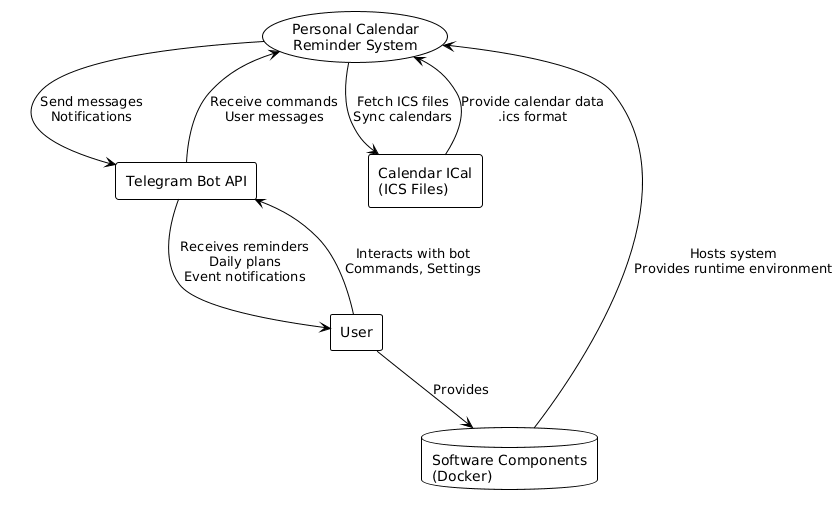
| Actor | Description |
|---|---|
| Calendar ICal | Calendar API that allow us to get .ics files |
| Telegram bot API | Telegram API that allow us to use telegram app as client side for our system |
| User | Person who interacs with tg bot and also hosting our system |
| Software components | Software that user need to install to hosting our system (example: Docker) |
Use case diagram
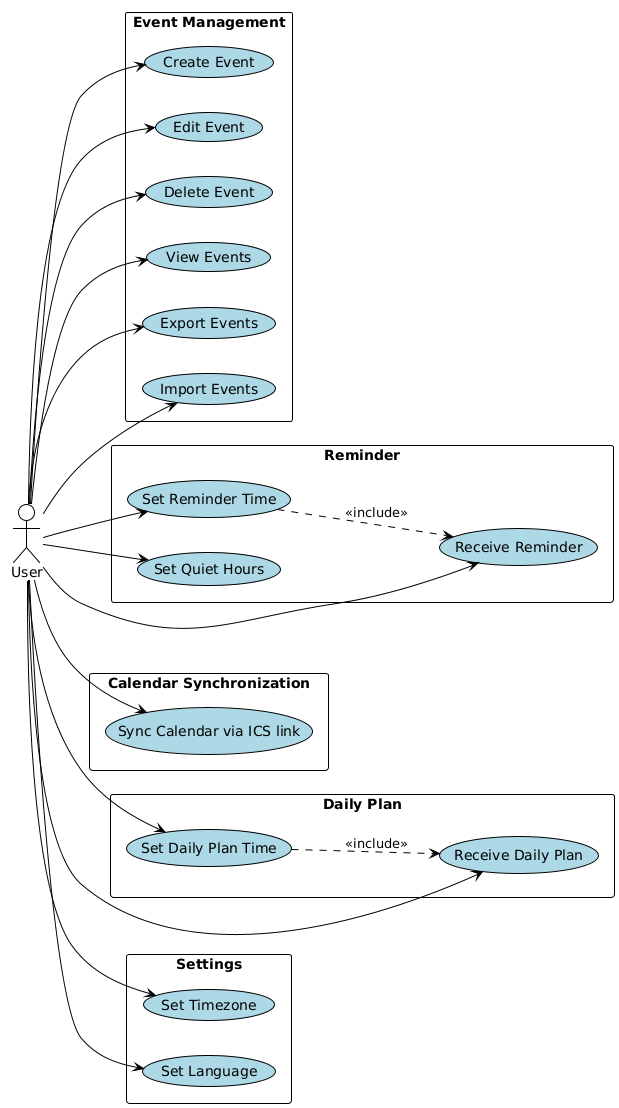
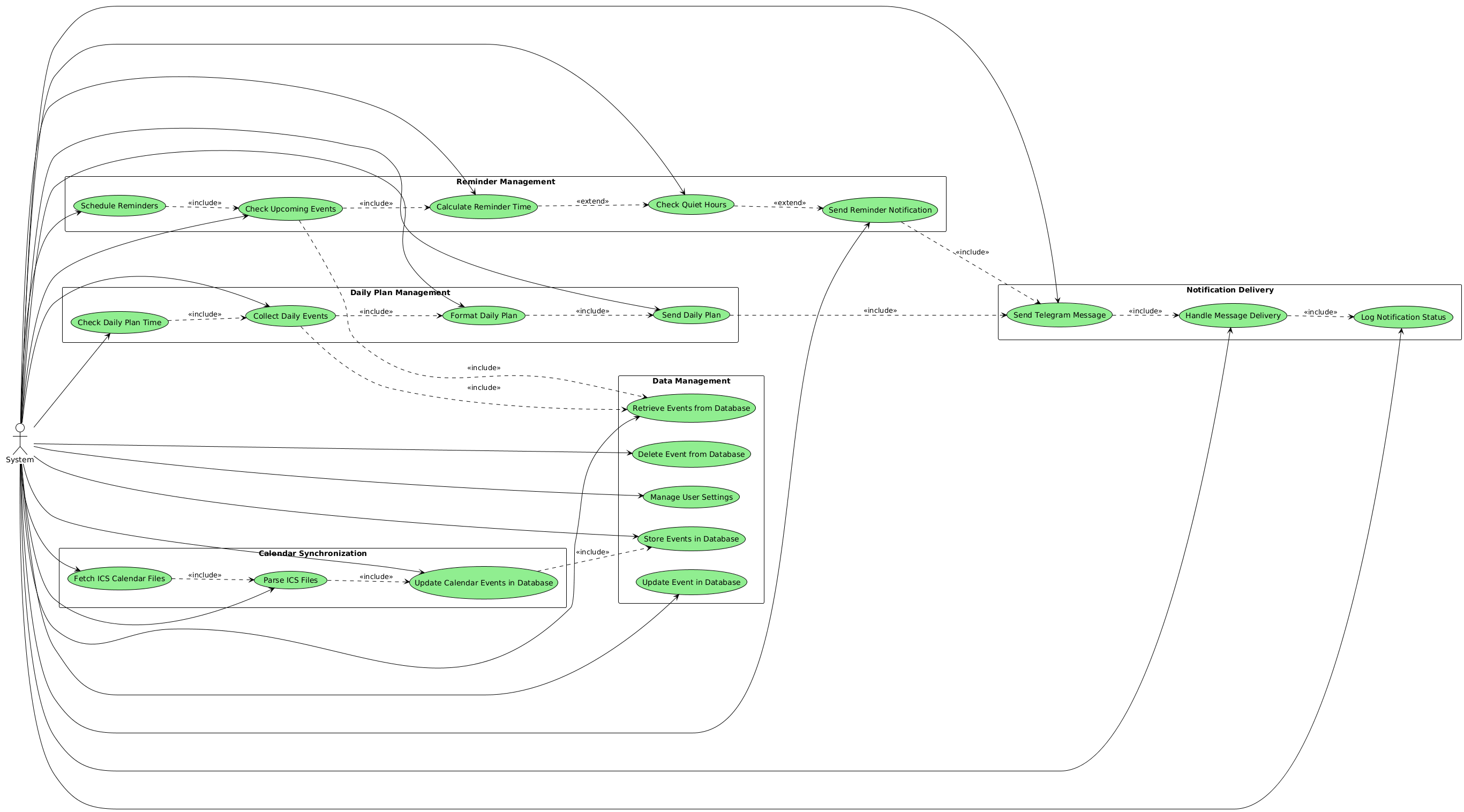
Чтобы не переусложнять диаграмму мы не добавили на нее TG API и Calendar API и нашу систему, т.к. нас интересует только то, как пользователь взаимдодействует с системой.
| Actor | Description |
|---|---|
| User | Person who interacts with system via TG bot interface |
| System | Our personal calendar that store and manage events and throw notifications |
Component diagram
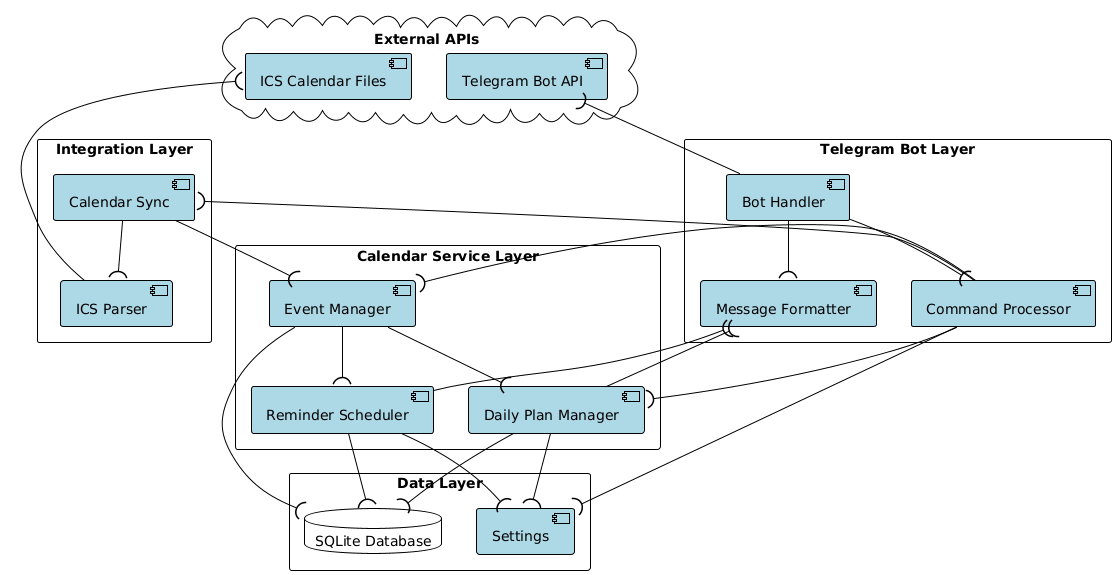
| Component | Layer | Responsibilities |
|---|---|---|
| Bot Handler | Telegram Bot Layer | Receives messages from Telegram API, routes commands to Command Processor, coordinates with Message Formatter |
| Command Processor | Telegram Bot Layer | Processes user commands, coordinates with Event Manager, Calendar Sync, Daily Plan Manager, and Settings |
| Message Formatter | Telegram Bot Layer | Formats messages for Telegram API output, prepares reminders and notifications |
| Event Manager | Calendar Service Layer | Manages CRUD operations for events, stores data in database, coordinates with Reminder Scheduler and Daily Plan Manager |
| Reminder Scheduler | Calendar Service Layer | Schedules and sends event reminders, respects quiet hours, formats reminder messages |
| Daily Plan Manager | Calendar Service Layer | Generates and sends daily event summaries, uses user settings for timing and format |
| Calendar Sync | Integration Layer | Synchronizes external calendar data, coordinates with ICS Parser and Event Manager |
| ICS Parser | Integration Layer | Parses ICS calendar files from external sources, extracts event data |
| Settings | Data Layer | Manages user settings and preferences (timezone, quiet hours, notification frequency) |
| SQLite Database | Data Layer | Stores persistent data including events and settings |
| Telegram Bot API | External APIs | External API for receiving commands and sending messages to users |
| ICS Calendar Files | External APIs | External source for calendar data in ICS format |
Architectural decisions
This section describes the relevant architectural decisions that resulted in the current architecture.
| Driver | Decision | Rationale | Discarded Alternatives |
|---|---|---|---|
| QAS002: Reliable Reminder Scheduling | Implement reminder scheduler that stores only the nearest notification and use event-based model instead pooling | - Avoids delays in notifications - Eliminates need for notification queues - Prevents constant polling of all events - Reduces memory usage and complexity |
- Storing notification queues: Would require more memory and complex queue management - Polling all events periodically: Would cause delays and unnecessary resource consumption |
| CON-3: Easy setup & CON-2: Self-hosting with Docker Compose & US-014: Self-host | Use Docker for self-hosting deployment | - Simplifies deployment process - Provides consistent environment across different systems - Aligns with self-hosting requirement - Enables easy setup if user already has docker |
- Deployment without containerization: Would require manual environment setup and be more error-prone |
| CON-4: Synchronize via ICS file links & US-006: Sync external calendar | Use ICS links for calendar integration instead of calendar API authorization | - Simple integration with external calendars - No need for OAuth/authentication per calendar service - Works with any calendar that provides ICS export - Reduces security complexity |
- Authorization to each calendar service: Would require OAuth implementation for each provider and increase complexity |
| CON-7: Open-source, MIT license | Adopt layered service architecture with clear separation of concerns | - Beneficial for open-source projects - Enables modular development and contributions - Improves code maintainability and testability - Facilitates understanding for new contributors |
- Monolithic architecture: Would limit modularity and make contributions more difficult |
| CON-6: Single-user per instance & US-015: Single-user restriction | One user per instance with no data storage or authorization system | - Simplifies architecture significantly - No need for multi-user data management - Eliminates authentication complexity - Reduces security attack surface |
- Authorization system: Would add unnecessary complexity for single-user use case - Configuration-based user management: Would still require user management infrastructure |
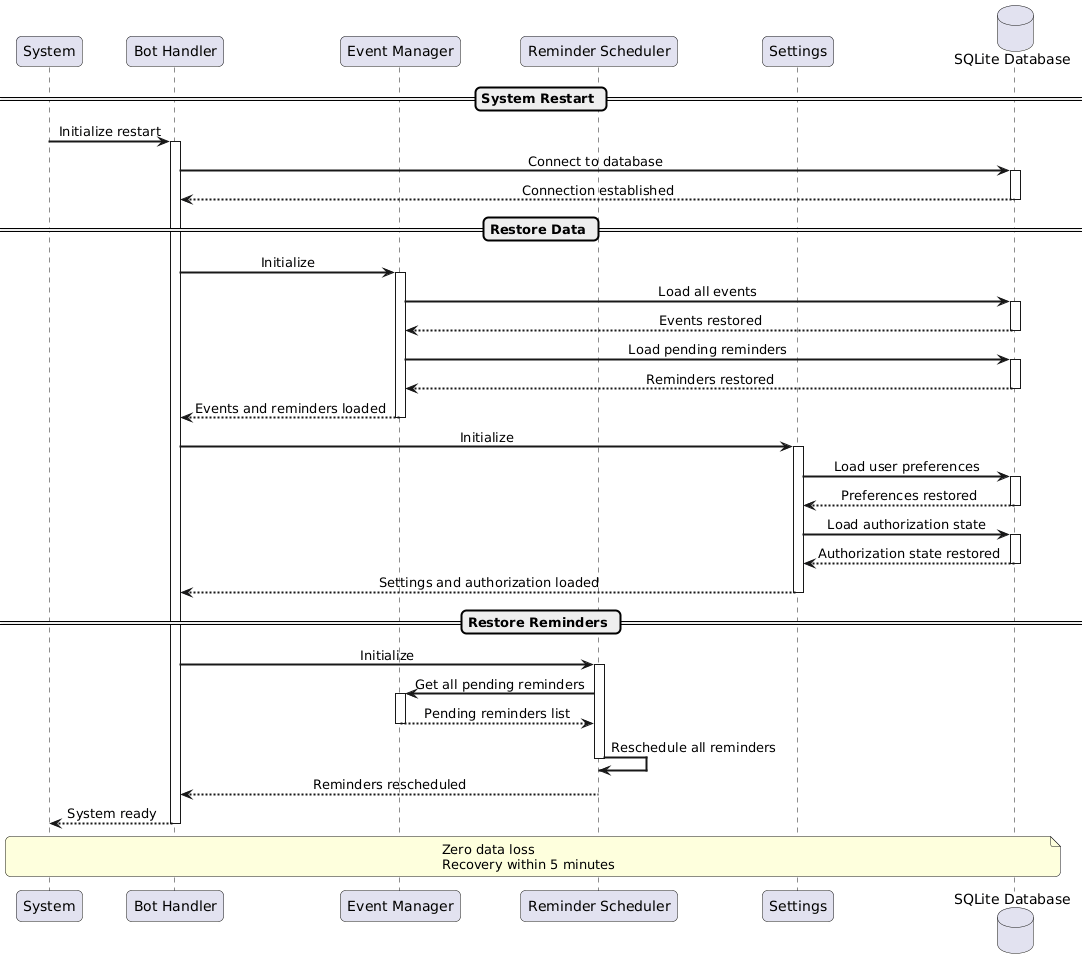
Sequence diagrams
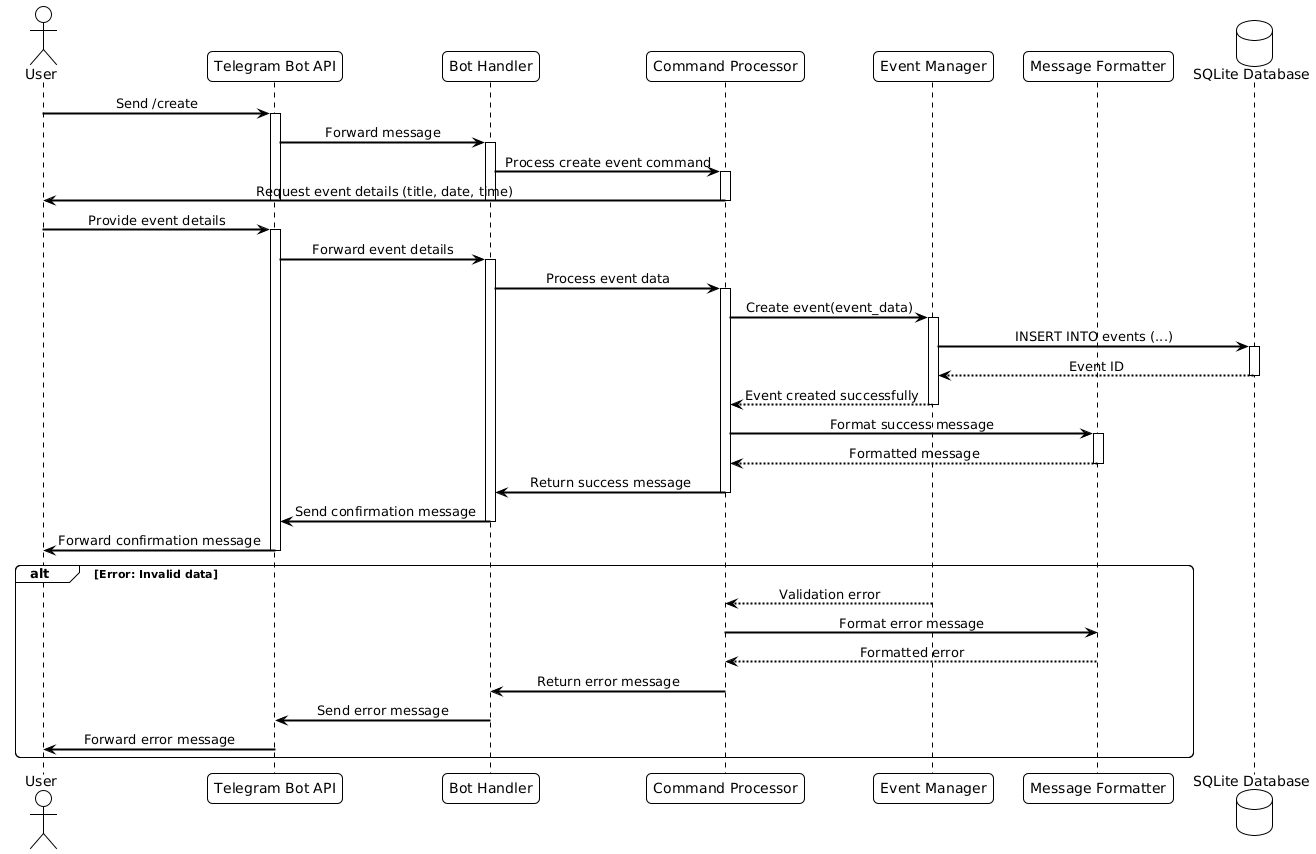
US001
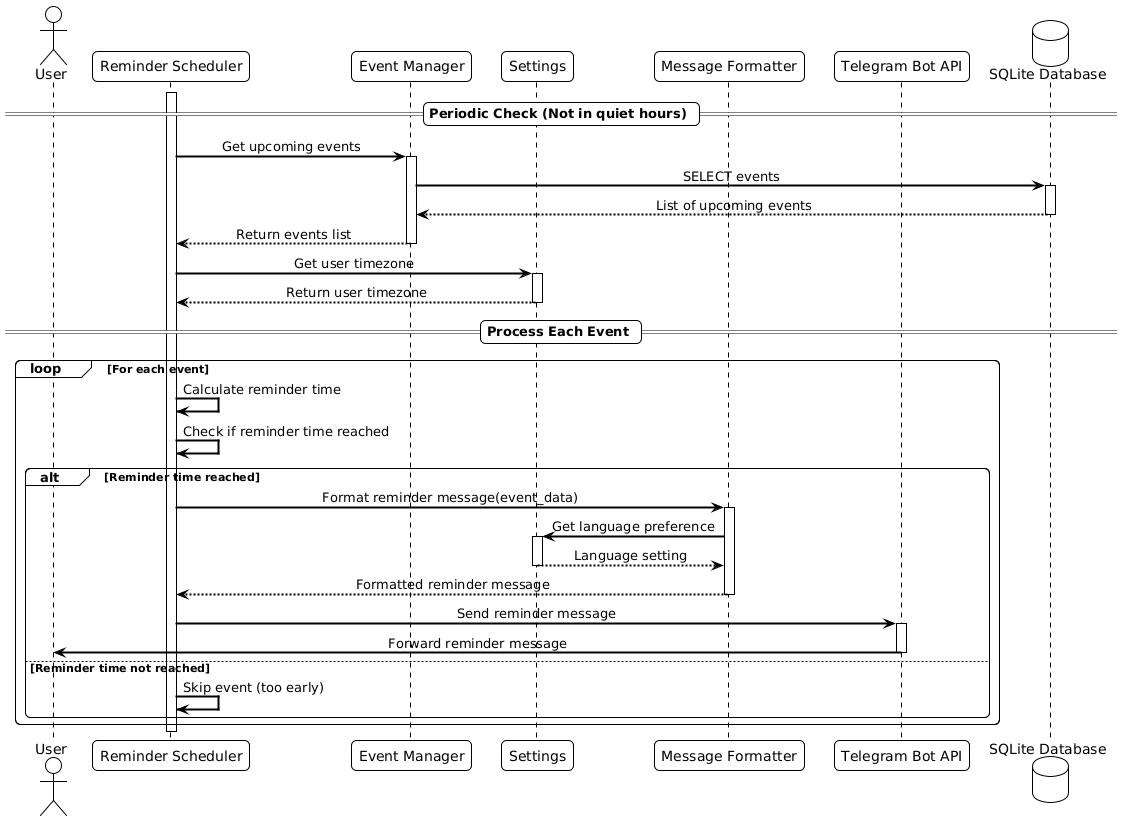
US009
QAS002
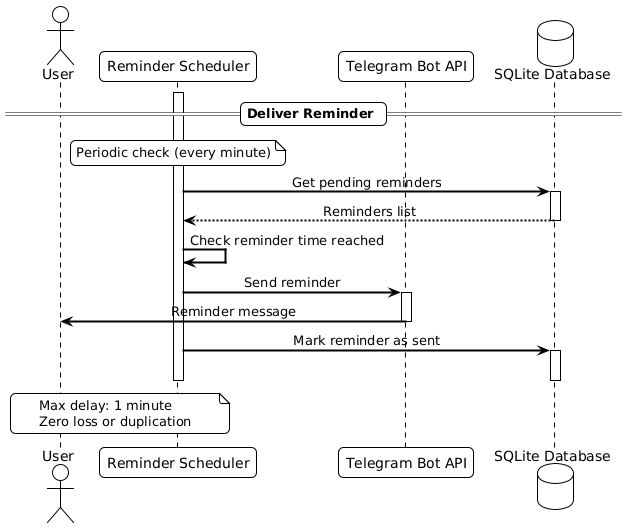
QAS007